A Week of Outages, Technical Failures, and Questions About National Preparedness
What happens when independent systems begin experiencing failures within the same narrow window of time?
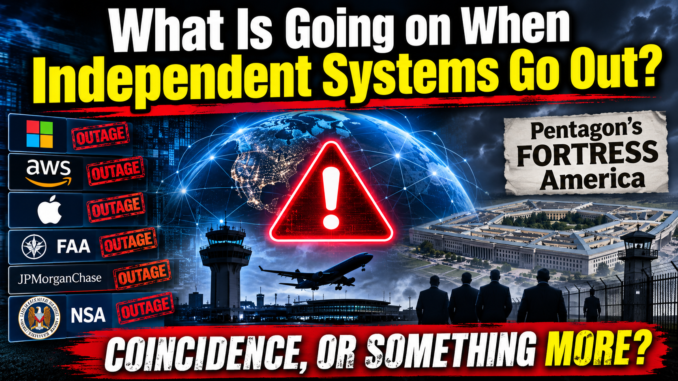
Between November 12 and November 18, 2026, a series of disruptions affected major technology companies, financial institutions, aviation systems, and even the classified communications network of the National Security Agency.
Individually, these incidents were attributed to technical problems, software glitches, routine maintenance, network upgrades, or equipment failures. But when several independent systems experience significant disruptions within just a few days, it raises a larger question: Are we simply witnessing a series of unrelated technical failures, or are these incidents revealing something more concerning about the security and stability of America’s critical infrastructure?
The timing deserves attention, particularly when considered alongside other developments involving national security, Pentagon preparedness, and reports that senior government officials are relocating to military installations.
Listen to “Special: A Week of Outages: Coincidence or Warning” on Spreaker.
A Series of Disruptions Across Independent Systems
The sequence began with Microsoft 365, where widespread service disruptions affected Outlook, Teams, and other business services. Microsoft attributed the problem to an earlier software defect, network capacity issues, and changes within its infrastructure. The company reported no indication of malicious activity.
On November 13, the Federal Aviation Administration experienced a much more consequential disruption. A telecommunications problem prompted a nationwide ground stop, temporarily halting departing flights across the United States. The FAA pointed to excessive network traffic associated with newly installed routers during a network modernization project. The agency subsequently paused further router installations while investigating the problem. Thousands of flights were disrupted.
The disruptions continued over the following days:
- Workday: A disruption affected business services, including payroll and human resources functions, following problems involving disaster-recovery testing.
- AWS: Amazon Web Services experienced connectivity and authentication problems affecting services in its US-East-1 region.
- JPMorgan Chase: Customers experienced transaction and payment disruptions, which the bank attributed to a software problem.
- United Airlines: A technology failure involving flight-planning and aircraft weight information delayed departures.
- Apple: On November 17, several Apple services, including iCloud, the App Store, and AppleCare, experienced disruptions following an internal update.
- National Security Agency: The NSA’s classified internal communications network, NSANet, experienced a significant disruption during what the agency described as scheduled routine maintenance. Personnel were directed to stagger their arrival times, and backup systems were used to maintain essential operations.
These were not all the same type of failure. They involved different organizations, different equipment, and different technical explanations. Nevertheless, the concentration of disruptions within such a short period is difficult to overlook.
Why So Many Maintenance and Upgrade Problems at Once?
One recurring explanation deserves particular attention.
We repeatedly heard variations of the same explanation: routine maintenance, software updates, network upgrades, security patches, and technical changes.
The question is not whether these things happen. They certainly do. Modern infrastructure requires constant maintenance, and older systems must be upgraded to address vulnerabilities.
But why were so many significant changes and maintenance operations occurring across different systems during the same period?
There is another development worth considering. Officials have discussed the growing role of artificial intelligence in identifying software vulnerabilities. The discovery of serious PHP security vulnerabilities, reportedly accelerated by AI-assisted research, triggered an urgent effort to patch affected systems.
The NSA outage has specifically been linked by news reports to efforts to apply security patches addressing these vulnerabilities.
This offers a possible explanation for some of the simultaneous technical problems. Director of National Intelligence Jay Clayton and other officials have suggested that the rush to update vulnerable systems contributed to disruptions.
That explanation may seem legitimate on the surface. But it also reveals how vulnerable our infrastructure can become when organizations are forced to make widespread changes under pressure.
And it leaves another question: If the discovery of software vulnerabilities is accelerating, are we adequately prepared for the possibility that hostile actors could exploit those same weaknesses before they are corrected?
The Pentagon’s FORTRESS America Program
While these disruptions were occurring, another development deserved attention.
On September 30, the Pentagon announced the establishment of FORTRESS America, a Department of War program intended to strengthen the nation’s military infrastructure and its ability to operate under adverse conditions.
The program addresses several areas, including:
- Energy independence.
- Supply-chain and defense-industrial resilience.
- Strategic defense reserves.
- Military installation hardening and cybersecurity.
- Resilience in space and communications infrastructure.
The stated objective is to ensure that military operations can continue under difficult circumstances, including disruptions to essential resources and infrastructure.
This is not an ordinary announcement about modernizing equipment. It is a broader effort to prepare the military for conditions in which critical resources, communications, and infrastructure may become unavailable.
Of course, military preparedness is an ongoing responsibility. FORTRESS America does not establish that officials anticipate an imminent national emergency, nor does its existence prove that the recent outages are connected to it. Some tell me that they have had this plan active for a while, just that it recently got reported on mainstream.
Nevertheless, its timing alongside growing concerns about cyber vulnerabilities and infrastructure reliability raises a reasonable question: What kinds of disruptions is the government preparing to withstand, and why is this level of resilience receiving such attention now?
Listen to “Special Report: Pentagon Fortress Preparedness Warning” on Spreaker.
Government Officials Moving Behind Military Gates
There is another development that adds to the picture.
Reports in November revealed that several senior Trump administration officials have been living in military or protected government housing.
Among those reported to be residing on military installations are Secretary of State Marco Rubio, Defense Secretary Pete Hegseth, White House Chief of Staff Stephen Miller, Attorney General Todd Blanche, and Treasury Secretary Scott Bessent.
Some of these arrangements predate the November outages. Bessent’s reported relocation, however, followed heightened security concerns and threats reportedly linked to Iran.
These moves have been explained in terms of personal security and protection against threats. They should not automatically be interpreted as evidence that officials are preparing to shelter from a national catastrophe.
But when senior government officials increasingly seek the protection of military installations, while the Pentagon is strengthening domestic military resilience and critical systems are experiencing repeated disruptions, the broader security environment deserves examination.
Coincidence, Vulnerability, or Something More?
The official position has been that there is no evidence connecting the outages to a coordinated cyberattack or hostile foreign actor.
Secretary of State Marco Rubio described the incidents as separate events with different causes. Director of National Intelligence Jay Clayton likewise rejected the suggestion that the disruptions represented a coordinated attack.
President Trump also downplayed the concerns, suggesting that technical problems of this nature happen. He stated, “Things happen. Everything is fine.”
We should acknowledge those statements. We should also acknowledge that no publicly established evidence has demonstrated that these incidents were coordinated.
But that does not mean there is nothing worth investigating since the government withholds information from the public.
Consider what happened within this relatively short period:
- Major Microsoft services experienced widespread disruption.
- A nationwide FAA ground stop interrupted air travel.
- Financial institutions and airline operations encountered technical failures.
- Apple services experienced outages.
- The NSA’s classified communications network was disrupted.
- Security vulnerabilities prompted urgent patching efforts across government and private-sector systems.
- The Pentagon was advancing a program focused on military resilience and infrastructure independence.
- Senior government officials were increasingly relying on military housing amid heightened security concerns.
These developments do not establish a single cause. But together, they illustrate how much of our national infrastructure depends on systems that can become vulnerable, disrupted, or unavailable.
My concern is not limited to whether a cyberattack caused these particular outages. It is also about the possibility of a larger vulnerability that could be exploited during a period of international tension or national security crisis.
What happens if communications, transportation, financial services, and government networks experience simultaneous disruptions during an actual emergency?
How much of the country could continue operating?
And are we being prepared for a future in which the stability of these systems can no longer be taken for granted?
The Questions Remain
I have raised these concerns in my recent podcast discussions, examining the November 13 disruptions, the possibility of cyber-related activity, the growing role of AI in cybersecurity, and the broader implications of these developments.
I am not claiming that every outage was part of a coordinated operation. Nor am I suggesting that the government has confirmed an impending attack or national emergency.
But I am questioning whether we should dismiss the overall pattern simply because each incident has been assigned its own technical explanation.
There is a difference between proving that events are connected and recognizing that their timing, circumstances, and implications deserve scrutiny.
The United States is increasingly dependent on interconnected digital infrastructure. Transportation, communications, financial services, intelligence, and government operations all depend on systems that must function reliably.
If those systems are becoming increasingly vulnerable, the consequences extend far beyond an inconvenient service interruption.
In addition I would also question that if 13 States are vulnerable because their infrastructure cannot take the utility stress, then why do they continue to press for more strenuous technology, why do they insist on Data Centers, why do they move towards 6G and beyond, why is AI running our affairs?
We have to consider if reckless decisions supersede sensibility. What is the great urgency? We just put ourselves into a deeper hole and make further complications.
False Flag
The elephant in the room must be addressed. The consideration that Israel has warned Intelligence agencies of a possible (if not imminent) attack from Iran holds weight. The Zionist nation wants the United States to continue its resistance on Iran for their sake.
The government is capable of false flags that plant something with another nation tagged to it as an excuse to go after that nation. Iran may not have the capability, but Israel does.
So what is really going on when independent systems begin going out within days of one another?
Is this simply the consequence of aging infrastructure, rushed upgrades, and an increasingly complicated technological environment?
Are we witnessing the early signs of a much larger cybersecurity problem?
Or is there something else developing that we have not yet been told?
Those are questions worth asking, and I don’t believe they should be dismissed. Nor shall we take for granted the Official Narrative. They have been known to lie to us about reality.